


Over the past two years, Toronto’s condominium market has been defined by cautious buyers, rising inventory, and headlines suggesting a slowdown. Many prospective buyers have chosen to wait, hoping for greater certainty before making a decision.
Yet beneath those headlines, a different story is beginning to emerge.
A Montreal-based investment firm recently purchased approximately $30 million worth of unsold Toronto condominium units and announced plans to invest up to $500 million over the next year. According to the company, several factors influenced its decision, including attractive pricing, strong rental demand, expectations of reduced future housing supply, and Ontario’s temporary HST rebate.
The announcement itself is significant, but the real story isn’t who made the investment.
It’s why they chose to invest now.
Understanding that decision provides valuable insight into how today’s housing market is evolving and what buyers, sellers, and investors should be watching over the coming years.

Blog
What Happened?
A Montreal-based investment firm recently acquired approximately $30 million worth of newly completed but unsold condominium units in Toronto. According to public reports, this represents the first phase of a strategy that could grow to $500 million in condominium acquisitions over the next 12 months.
Rather than purchasing these properties for immediate resale, the firm’s strategy is to lease the units, generate rental income, and hold them until market conditions improve before gradually selling the properties over the coming years.
In explaining the decision, the company cited several reasons for moving forward, including discounted purchasing opportunities created by today’s market conditions, Ontario’s temporary HST rebate, strong rental demand, and expectations that future condominium supply could become more limited.
While this is only one investment, it offers an interesting perspective on how experienced investors evaluate opportunities during periods of market uncertainty.
Looking Beyond the Headlines
It’s easy to look at today’s condominium market and focus on higher inventory, slower sales, or softer pricing.
Institutional investors often look at the same market differently.
Instead of asking whether today’s market is strong or weak, they ask whether today’s conditions create long-term value.
In this case, the investment firm’s strategy wasn’t built around expecting an immediate market recovery.
It was built around acquiring quality condominium units at discounted pricing, generating rental income while the market adjusts, and positioning those properties for the future.
This approach reflects a different way of thinking.
Rather than trying to predict the exact bottom of the market, experienced investors often focus on whether today’s pricing, rental income, and long-term housing fundamentals create an attractive opportunity over several years.
That doesn’t guarantee future appreciation, but it demonstrates how long-term investment decisions are often driven by market fundamentals rather than short-term sentiment.
Why the Ontario HST Rebate Matters
One of the most interesting aspects of this announcement was the role Ontario’s temporary HST rebate played in the investment decision.
While the rebate is often discussed in the context of homebuyers, its broader purpose is to encourage housing investment and improve the financial viability of qualifying residential projects.
For institutional investors purchasing multiple units, reducing acquisition costs can significantly improve the economics of an investment.
Combined with discounted pricing available in today’s market, the rebate helped strengthen the financial case for moving forward now rather than waiting.
This illustrates an important point.
Government housing policies don’t simply reduce costs—they can influence the timing of investment decisions, encourage housing activity, and help maintain confidence during slower market cycles.
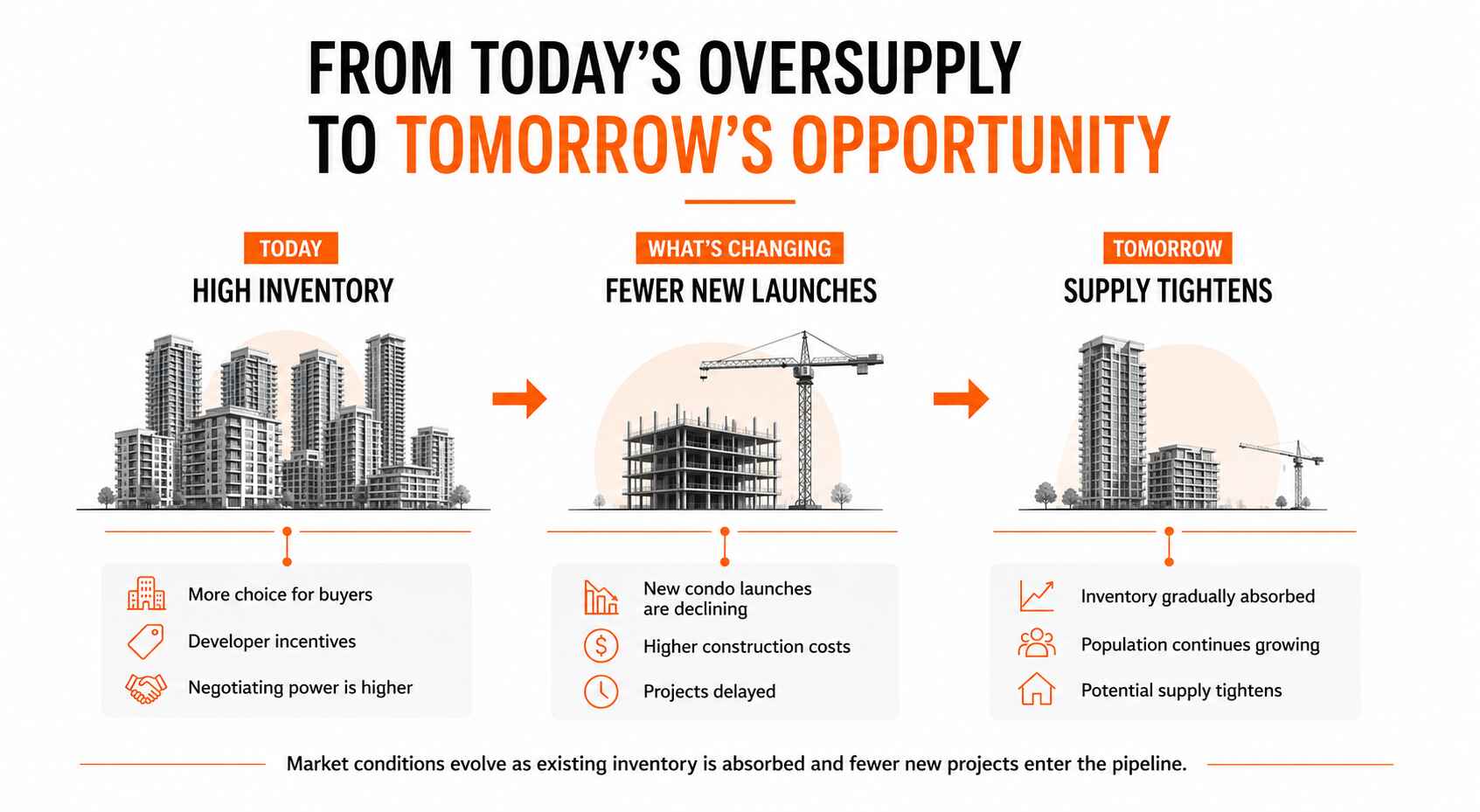
Could Today’s Oversupply Become Tomorrow’s Shortage?
One of the most important trends shaping today’s condominium market isn’t the inventory buyers see today—it’s the supply that may not exist tomorrow.
Many of the condominium units currently entering the market were planned and built several years ago under very different economic conditions.
Today, however, higher construction costs, financing challenges, and slower pre-construction sales have caused many planned developments to be delayed or cancelled.
That creates an important shift in the supply pipeline.
Today’s market may appear oversupplied because projects that began years ago are now reaching completion. However, significantly fewer new projects are entering the development pipeline to replace that inventory.
If today’s completed units are gradually purchased or rented while fewer new homes are built over the next several years, the balance between supply and demand could begin shifting once again.
This is one reason experienced investors may be looking beyond today’s market conditions and focusing instead on where housing supply could be several years from now.
What It Means for Buyers
Today’s buyers are entering a market that offers something many haven’t seen in years: greater choice, increased negotiating power, and more opportunities to compare properties carefully before making a decision.
At the same time, buyers should recognize that today’s market conditions are also attracting long-term investors.
That doesn’t mean buyers should rush into the market or assume prices will rise immediately. Every purchase should be based on individual financial circumstances and long-term goals.
However, understanding why sophisticated investors are purchasing during a slower market can provide useful perspective.
Many are looking beyond today’s headlines and evaluating what the market could look like once current inventory is absorbed and future housing supply becomes more limited.
What It Means for Sellers
Although this investment focuses on unsold developer inventory, it also reinforces confidence in Toronto’s long-term housing market.
Today’s buyers are more selective and value-conscious than they were during previous market cycles. As a result, pricing strategy, presentation, and marketing remain essential for achieving successful outcomes.
Sellers should also recognize that housing markets evolve continuously. As inventory is gradually absorbed and fewer new condominium projects enter the market, competitive conditions may begin to shift.
Understanding these broader trends can help sellers make more informed decisions about timing and strategy.
What It Means for Investors
Perhaps the most valuable lesson from this announcement isn’t the size of the investment—it’s the strategy behind it.
The firm’s approach is based on acquiring properties at favourable pricing, generating rental income that helps offset carrying costs, and holding those assets while the market continues to adjust.
Ontario’s temporary HST rebate further improves the financial case by reducing acquisition costs on qualifying purchases.
This illustrates how experienced investors often focus on cash flow, long-term housing demand, and future supply rather than attempting to predict short-term price movements.
For individual investors, the lesson isn’t to copy institutional strategies, but to understand the market fundamentals influencing their decisions.
What Readers Should Watch Next
Several factors will play an important role in shaping Toronto’s condominium market over the coming years:
- The pace at which today’s condominium inventory is absorbed.
- New condominium project launches across the GTHA.
- The continued impact of Ontario’s temporary HST rebate.
- Interest rate decisions and borrowing costs.
- Population growth and long-term housing demand.
- Government policies aimed at increasing housing supply.
Together, these factors will help determine how today’s market evolves into tomorrow’s opportunities.
Final Thoughts
One investment does not determine the future of Toronto’s housing market.
However, it does provide valuable insight into how experienced investors evaluate opportunities during periods of uncertainty.
While many headlines focus on today’s inventory and slower sales, long-term investment decisions are often shaped by a much broader picture—government policy, housing supply, rental demand, and future market fundamentals.
Rather than asking whether today’s market is good or bad, a more valuable question may be: What could today’s conditions mean for the market several years from now?
At Dream House Real Estate, we believe the best real estate decisions come from understanding the bigger picture. Whether you’re buying your first home, selling a property, or exploring long-term investment opportunities, our team is here to help you navigate changing market conditions with trusted guidance, thoughtful strategy, and insights that put your goals first.
Source References
- REM Real Estate Magazine. Montreal Real Estate Firm Bets $500M on Toronto’s Condo Glut.
- The Globe and Mail. Montreal developer Jesta invests in Toronto condominium market.
- Urbanation. Greater Toronto and Hamilton Area Condominium Market Reports.
- Government of Ontario. Ontario HST Rebate Program.